Coaches Manual
Cedar
Mill Baseball
Book I: Manager
Book II: Drills
|
|
A Modern Coaching Philosophy
Our mission is twofold: provide a fun, positive, and developmental experience, while
fostering a healthy competitive environment. The most effective way is through
collaborative, high-energy practices.
Collaborative Practices
Partner with another team! It allows for full scrimmages, more coaches per player, and
shared knowledge. Maximize reps, minimize standing around.
Building Your Staff
- Head Coach (Manager): The CEO. Overall strategy, practice planning,
parent communication.
- Bench Coach: The "In-Game Manager". Lineups, substitutions, game flow,
pitch counts.
- Base Coaches: Instruction on the paths.
- Team Parent: The "MVP". Admin, snack schedules, Game Changer logistics.
Player Evaluation (The 5 Tools)
Use the first few practices to assess:
- Hitting for Average
- Hitting for Power
- Fielding
- Arm Strength
- Speed
Goal: Versatility. Avoid pigeonholing players early.
Communication is Key
The First 24 Hours
Your first contact sets the tone. Do not just email.
Script: The Player Phone Call
"Hi [Player Name]! This is Coach [Name]. I'm so excited to have you on the team. We're going
to have a lot of fun and get better together. Can't wait to see you at practice on [Date]!"
The Parent Meeting Agenda
- Welcome: Coach introductions.
- Philosophy: Development > Winning. Effort > Outcome.
- Communication: GameChanger is the ONLY official tool.
- Expectations: Positive support only.
- The 24-Hour Rule: (See below).
Critical Tool: The 24-Hour Rule
Mandate that parents wait 24 hours after a game before discussing any emotional issue
(playing time, positions, strategy). This cooling-off period prevents emotional
confrontations.
Handling Common Coaching Challenges
- Managing Playing Time: Be transparent. Explain that "fair" does not
always mean "equal". Playing time is earned through attendance, attitude, and
effort.
- Parent Complaints: Always listen respectfully. Validate their
feeling ("I hear that you are frustrated"). Then, refer back to the 24-Hour
Rule. Do not engage in arguments immediately after a game.
End of Season Speech Template
"First, I want to thank every one of you. You brought energy and effort all season. Think
back to our first practice and look how much you've improved. You became teammates. My
favorite memory was [Insert Specific Moment]. Great job!"
Game Day Management
Pre-Game (45-60 Mins Before)
- Have lineup and substitution plan written on the Official Roster Sheet.
- Verify First Aid Kit and Equipment.
- Lead consistent warm-up.
In-Game
- Designate a Pitch Counter (Coach or Parent).
- Keep tactical decisions simple.
- Positive communication only.
Post-Game
- Short, positive talk focusing on effort. Do not dwell on the score.
Common Rules Misconceptions
- Dropped 3rd Strike: Batter runs if 1st is OPEN (or 2 outs). (Majors+).
- Infield Fly: Batter is OUT if pop-up is catchable with runners on 1st &
2nd (or loaded) with < 2 outs. (Runners advance at own risk).
- Obstruction: Defense impedes runner (Runner awarded base).
- Interference: Offense impedes fielder (Runner is OUT).
Health & Safety
Concussions: "When in doubt, sit them out."
Hydration: Mandate water breaks.
The All-Star Addendum
Coaching All-Stars shifts focus from broad development to optimizing for competitive success.
The Philosophy Shift
- Practices: More frequent, more intense.
- Playing Time: Earned, not guaranteed.
- Positions: Optimized for winning.
The Commitment Pact
"For the duration of the tournament, this team comes first. Other sports/activities must be
scheduled around our practices and games. If you cannot commit to this, we need to
know now."
The Coaches Contract (Higher Standards)
- Ejections: Any coach ejected for behavior is removed for the
remainder of the tournament.
- Manager Accountability: If an assistant is ejected, the Manager may
also be held accountable.
Dugout Culture
No temper tantrums. No throwing helmets. Positive, loud, respectful.
Evaluation Phase
- Phase 1: Foundational Practices: Building teamwork and installing
strategy.
- Phase 2: The Scrimmage Gauntlet: Scrimmage almost daily. Goal: Figure
out the best lineup combinations.
- Phase 3: Final Preparations: Refine strategies and dial in game plan.
Adaptable Practice Plans
Philosophy: Maximum Reps, Maximum Fun. Use stations.
Rules of the Road (Collaborative Practice)
- Meet for 5 mins before practice.
- Designate a Timekeeper.
- One Voice during scrimmages.
- Check your ego (It's about development).
Key Concept
Joint practices with another team, ending in a coach-led scrimmage, are the most effective
way to develop players.
- 0:00-0:15: Dynamic Warm-up & Throwing
- 0:15-0:55: 4 Stations (20m each side / 10m rotation)
- /
- /
- 0:55-1:45: Live Scrimmage (Coach Pitch)
- 1:45-2:00: Fun Finisher ()
- 0:00-0:15: Warm-up & Long Toss
- 0:15-1:00: Outfield Stations (, , )
- 1:00-1:45: Hitting Rotations ()
- 1:45-2:00: Conditioning ()
- High Rep (Tennis balls).
- .
- Pitching Mechanics ().
- .
The Coach's Gear Checklist
Bucket of balls (Count them! 25-30 is standard), Tee, Net, Cones (or gloves), First Aid Kit,
Catcher Gear.
Ball Management Rule
Baseballs are gold. Count them before and after practice. Every drill in this manual assumes
a constraint of ~25 balls. Run "Reset" breaks often to keep buckets full.
Dynamic Warm-Up
Objective: Prepare body for explosive movement. Static stretching is outdated.
- Jog: 2 Laps.
- High Knees: 60 ft.
- Butt Kicks: 60 ft.
- Carioca: 60 ft (Hip rotation).
- Arm Circles: 10 forward, 10 back.
- Trunk Twists: 10 reps.
- Throwing Progression: Wrist flips -> Full Throwing.
- Focus: Aim for the chest.
- Cue: "Show them your number!" (Front shoulder to target).
Infield Drills
3.1 Momentum Fielding Drill
 Charge, Field, Follow.
Execution: 3 cones in triangle. Coach rolls ball. Player charges, fields
with "Alligator Hands" out front, continues momentum through ball toward target.
Coaching Why: Prevents flat-footed fielding. Ensures stronger throws.
Modifications (AA/AAA)
Use foam or tennis balls. Focus only on the approach. Make it a game: "Who can get their
nose closest to the ball?"
3.2 4-Corner Infield Flip
 Flip and Follow.
Execution: Square formation. Flip underhand to next corner. Run to the
spot you threw to.
Progression: 1) Soft/High (Short square). 2) Firm/Fast (Double play
feed).
- Key Mechanics: Glove hand stays back (clear lane). Flip hand
presents ball out front. Walk through the flip.
3.3 Short Fungo Drill (Split Squad) High Reps
 Two Groups (SS & 2B). Two Coaches. Max Reps.
Objective: To achieve an extremely high number of repetitions in a short
time, focusing purely on hand-eye coordination (no throwing).
Execution:
- Split Squad: Divide infielders into two groups at Shortstop and
Second Base to minimize standing.
- Two Coaches: Each group has a coach kneeling 15-20 feet away.
- The Drill: Coaches hit/roll rapid-fire grounders simultaneously.
Players field cleanly and drop ball into an empty bucket next to them.
- Rotation (Ball Logic): With limited balls (12-15 per coach), run
sets of 10. After 10 reps, yell "RESET!" and everyone shags to refill the coach's
bucket.
Coaching Why
Isolating fielding from throwing allows players to focus 100% on glove work, watching
the ball in, and using two hands.
3.4 The "Everyday" Infield Fungo Core Routine
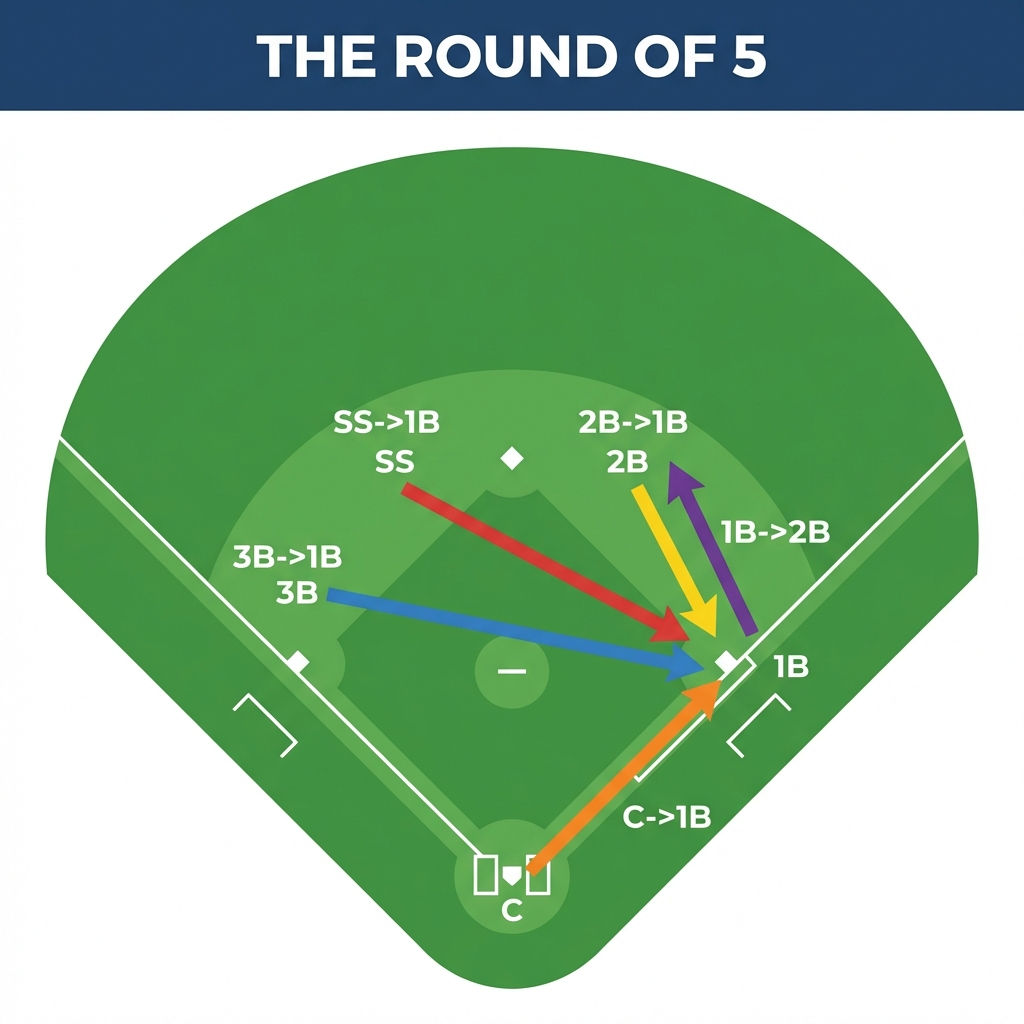 The 'Round of 5' Sequence.
Objective: The standard daily routine to practice fielding and long
throws across the diamond.
Setup: Players at standard positions. Coach hitting from home plate.
Execution (The "Round of 5"):
- Hit to 3B: Throws to 1B.
- Hit to SS: Throws to 1B.
- Hit to 2B: Throws to 1B.
- Hit to 1B: Throws to 2B (Starting D.P. feed) or 3B.
- Catcher: Coach rolls bunt, Catcher throws to 1B.
Progression:
- Round 1: "Get One" (Throw to 1B).
- Round 2: "Turn Two" (Feeds).
- Round 3: "Slow Roller" (Charge hard).
Coaching Why
Unlike Short Fungo, this forces players to read the ball off the bat and make long,
accurate throws.
Team Defense & Strategy
7.1 The "Split-Squad" Fungo Routine
Objective: To maximize reps by splitting the team and coaching staff.
Execution:
- Group A (Infield): Coach hits grounders from home. Infielders
practice "Everyday Fungo" (Drill 3.6).
- Group B (Outfield): Second coach hits fly balls from foul line.
Outfielders practice catching and hitting the cutoff man.
- Rotation: Switch groups after 15-20 minutes.
7.2 The Strings Drill (Cutoffs & Relays)
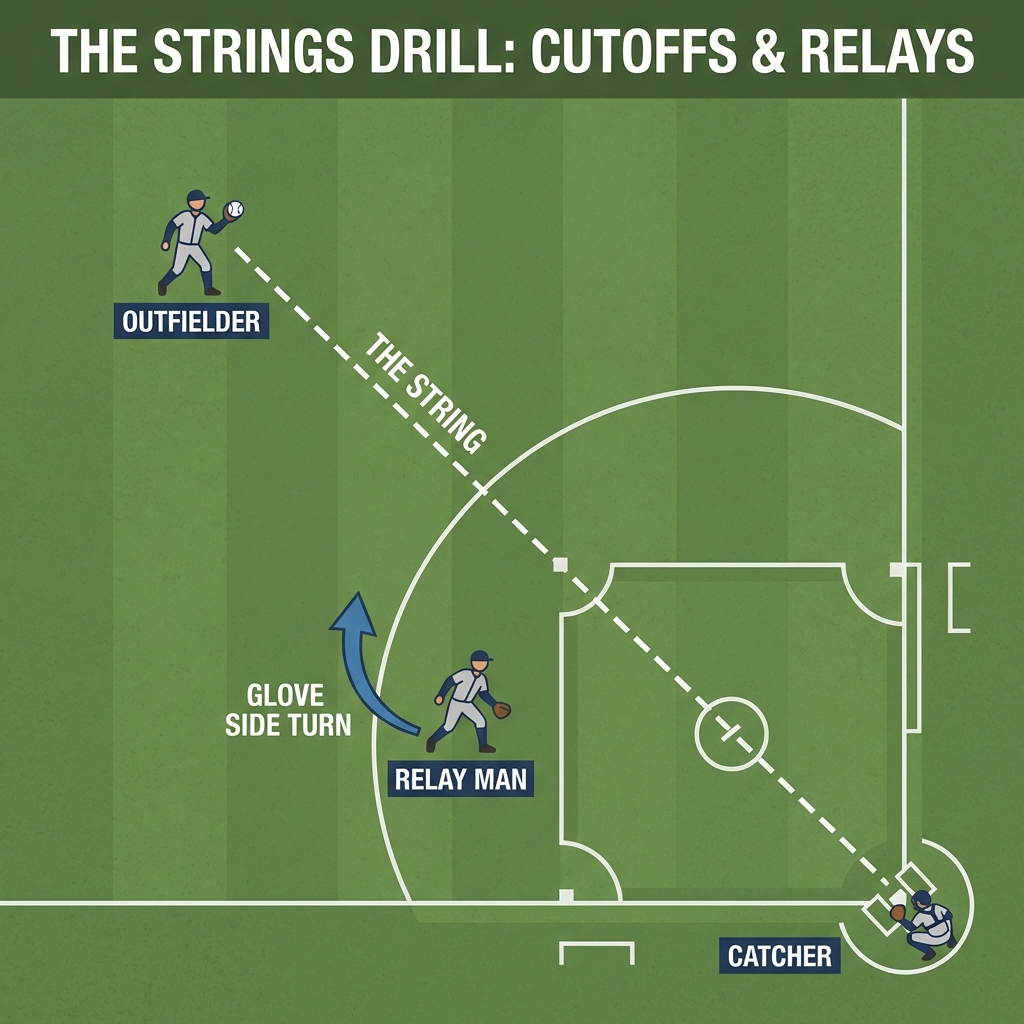 "The String" from Outfield to Home. Note the Glove-Side Turn.
Objective: To perfect the alignment and mechanics of relay throws from
the outfield.
Execution:
- Imagine a "String" connecting the Outfielder -> Relay Man -> Target (Base/Home).
- The Relay Man: Raise hands high ("Target!"). Catch the ball.
- The Turn: Turn towards your GLOVE SIDE. This keeps the feet moving
towards the target and is the fastest transfer.
Pro Tip The Relay Man should
"Wave" at the outfielder to be visible.
The Golden Rule: Minimize the distance of the throw. The Outfielder
throws to the Cutoff Man, not all the way home.
| Ball Hit To... |
Who Goes Out? |
Who Covers 2nd? |
| Right Field |
2nd Baseman |
Shortstop |
| Center Field |
Shortstop (usually) |
2nd Baseman |
| Left Field |
Shortstop |
2nd Baseman |
Pro Tip If the ball is hit to
the wall, use a "Double Cut" (Both middle infielders go out, roughly 20-30ft apart).
7.3 The Continuous Rundown ("Pickle")
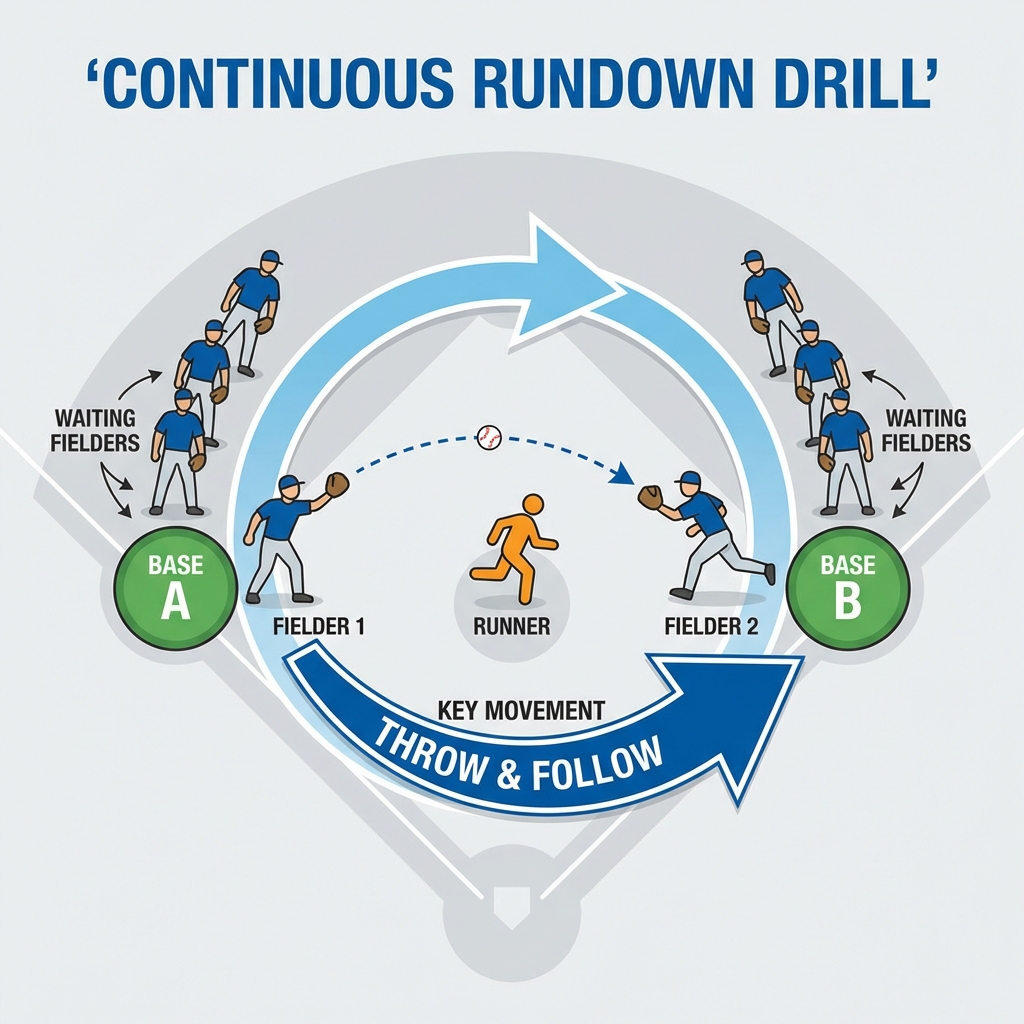 The Continuous Loop: Throw & Follow your throw to the next
line.
Setup: Split team into two groups at 1st and 2nd base. Runners in the
middle.
Execution (Fluid Reps):
- Fielder 1 runs hard at the runner -> Throws to Fielder 2.
- The Rotation: Immediately after throwing, Fielder 1 sprints to the
back of the line at Fielder 2's base.
- The drill continues in a loop until every player has rotated through multiple times.
Critical Rule "Run at him,
Throw, Follow." Get the out in 2 throws or less.
Regression (AA/AAA)
Start with a simple "3-Player Pickle" (One runner, two fielders). Don't require the
follow-your-throw rotation initially.
7.4 First-and-Third Defense
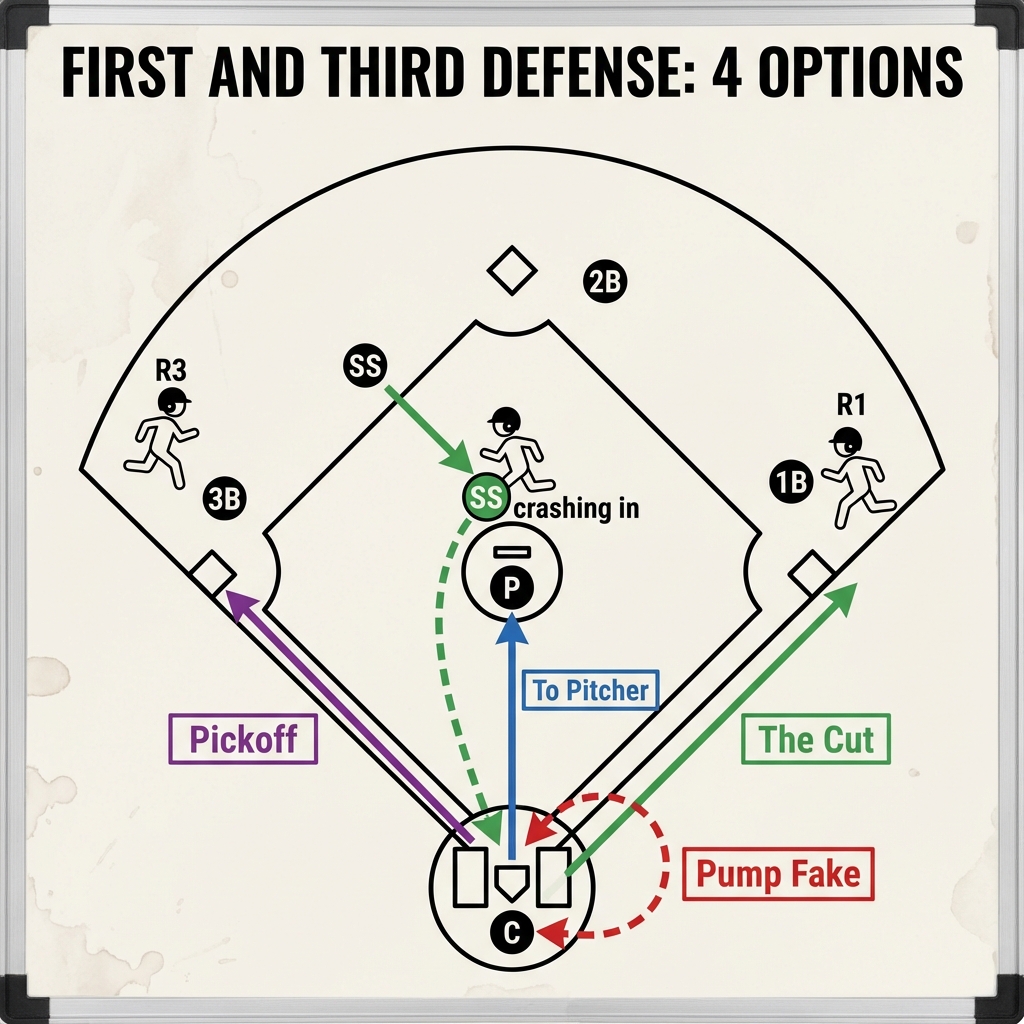 The 4 Options for the Catcher. Note Option C ("The Cut") with
SS crashing to the plate.
Scenario: Runners on 1st and 3rd. Runner on 1st steals 2nd.
- Option A (Pump Fake): Catcher hard fakes to 2nd, looks to pick off
runner at 3rd.
- Option B (To Pitcher): Rapid throw back to the Pitcher. Catches
runner on 3rd off guard.
- Option C (The Cut): Catcher throws to SS (who is crashing down
towards the plate). SS catches and immediately checks/throws home if runner on 3rd
bites.
- Option D (Pickoff): Catcher throws straight to 3rd base to catch
runner in a primary lead.
Modifications (AA/AAA)
This is an advanced concept. For younger divisions, focus strictly on the Catcher making
a strong, accurate throw to Second Base.
7.5 Standard Bunt Defense ("Corners Crash")
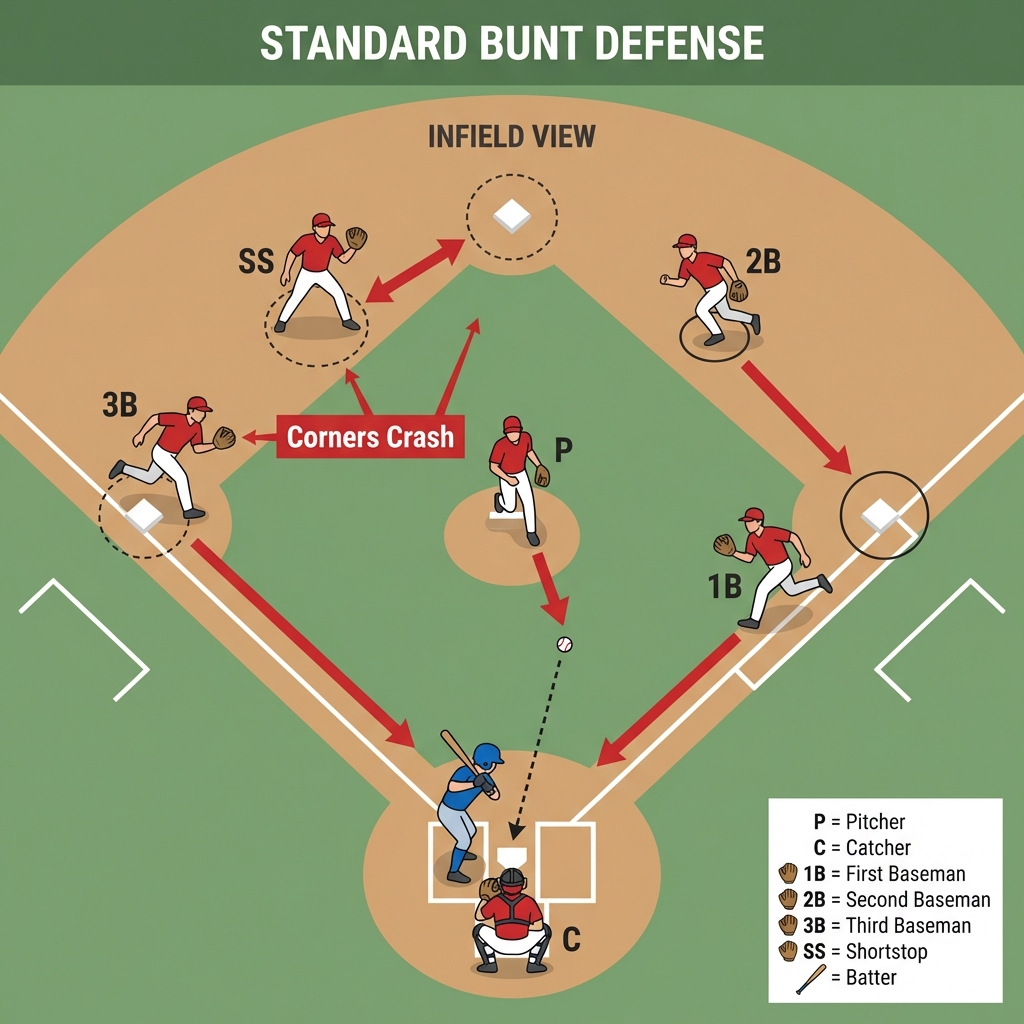 Corners Charge. Middle Infielders Rotate. Note: SS wears a
glove!
Scenario: Runner on 1st/2nd, < 2 Outs. Expecting a bunt.
Assignments:
- 3B & 1B: CRASH hard towards home plate as pitcher delivers.
- Pitcher: Cover the middle / 1st base line.
- 2B: Sprint to cover 1st Base.
- SS: Sprint to cover 2nd and 3rd Base (Read the play).
- Catcher: Call the play loudly ("First!", "Second!", "Eat
it!").
7.6 Pop-Fly Priority System
Objective: Avoid collisions. Loud communication.
- Hierarchy: Outfield > Infield > Pitcher > Catcher.
- The Rule: If a player with higher priority calls it ("BALL! BALL!
BALL!"), the lower priority player MUST peeling off immediately.
Outfield Drills
4.1 Outfield Star Drill
 The 5-Leg Star Pattern.
Execution (The 5 Legs):
- Leg 1: Start (Bottom-Left) -> Top (Over shoulder)
- Leg 2: Top -> Bottom-Right
- Leg 3: Bottom-Right -> Left (Backhand)
- Leg 4: Left -> Right
- Leg 5: Right -> Start (Coming in)
Coaching Why: Simulates every angle of catch.
4.2 Gap Communication
 Start between, Run AROUND.
Execution: Start between markers facing coach. Run AROUND outside.
Converge. One calls "I GOT IT!", other backs up.
Critical
Find ball in the air *after* the turn. Call it LOUD and EARLY.
Fun & Competitions
Objective: End every practice on a high note. These drills normalize pressure while keeping
energy high.
Objective: To practice performing under pressure in a fun, low-stakes
environment.
Setup:
- Split the team into two squads (Offense vs Defense).
- Scenario: "Bottom of the 6th, 2 Outs, Bases Loaded, Down by 1 Run."
Execution:
- Coach pitches to the batter.
- The defense must make the play to end the game.
- The offense tries to score the winning run.
- Switch sides after every batter or every 3 outs (Coach's choice).
Coaching Why This drill
normalizes the feeling of pressure. It gets players used to their heart beating faster
in a "big spot," so when it happens in a real game, it doesn't feel new.
8.2 "Around the Horn" Relay Race
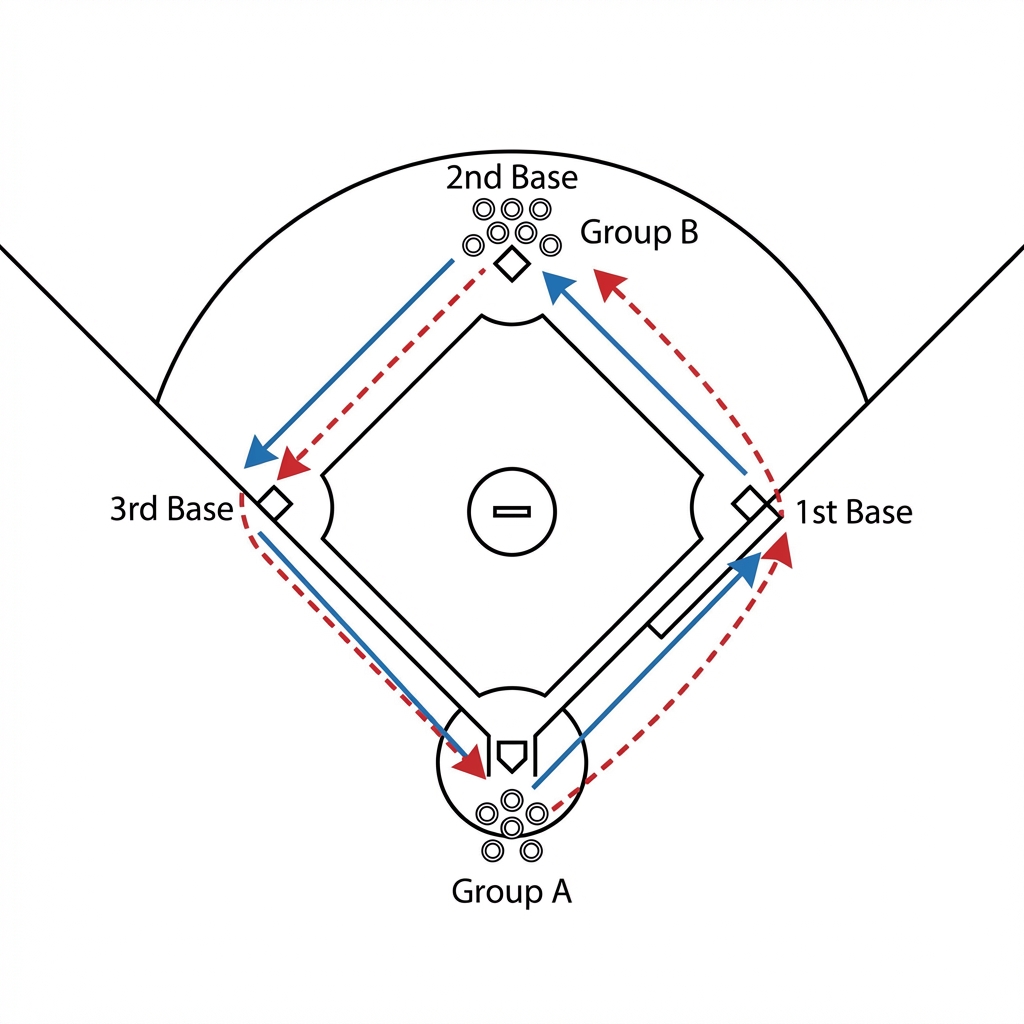 Group A (Home) and Group B (2nd) chase each other.
Objective: Conditioning disguised as high-pressure competition.
Execution:
- Split team into two equal squads.
- Group A: Lines up at Home Plate.
- Group B: Lines up at 2nd Base.
- The Race: On "GO!", the first runner from each team sprints one
full lap around the bases (Home-to-Home, 2nd-to-2nd).
- The Handoff: Hand the ball to the next runner in line.
- Winning: First team to finish all runners sits out dugout cleaning
duty!
8.3 Competitive Situational Scrimmage
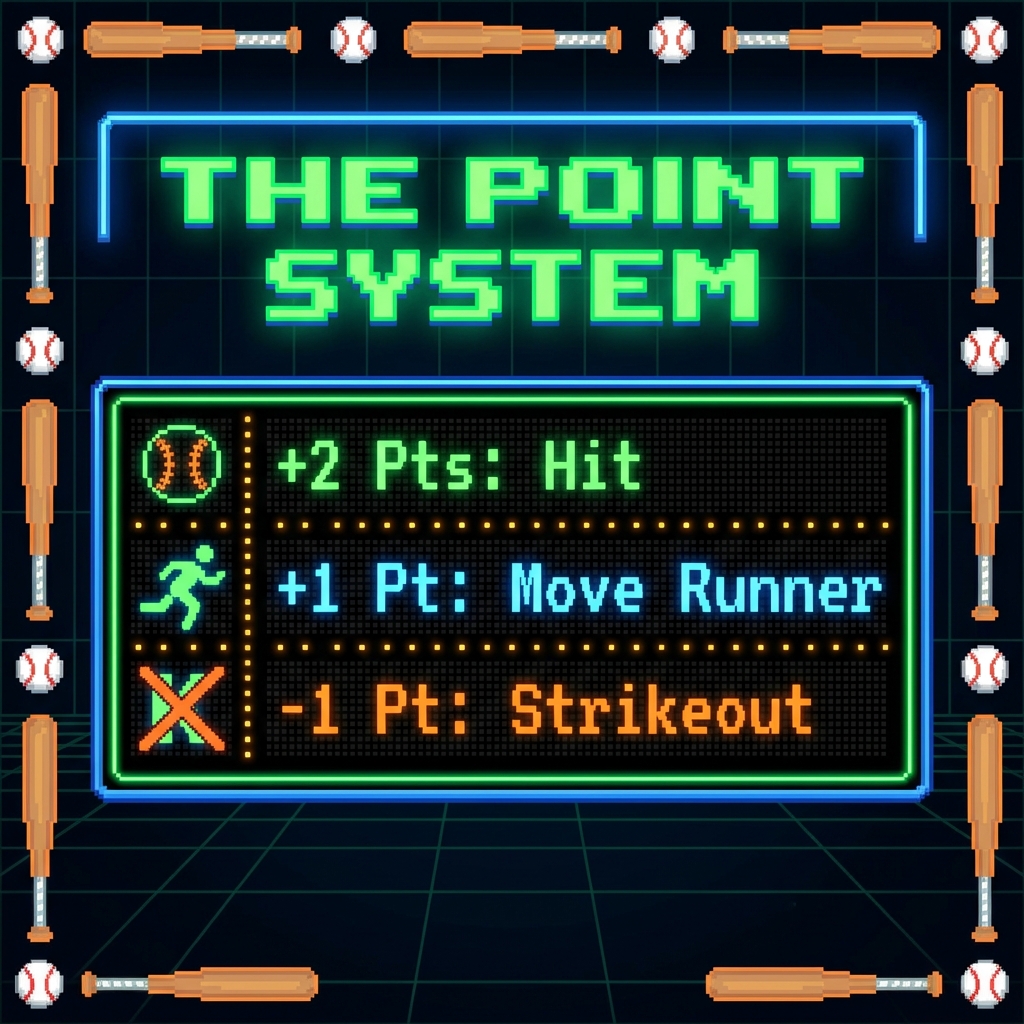 Gamify practice with points.
Start 1-1 count. Scenario: "Runner on 2nd".
- +2 Pts: Hit, Run or RBI
- +1 Pt: Productive Out (Move runner)
- -1 Pt: Strikeout
- 0 Pt: Pop-up
Coaching Focus Celebrate the
productive ground ball! It moves runners and scores runs.
Scrimmage Tip
Use a Coach to pitch for more strikes. Stop the game for "do-overs" to provide immediate
feedback.
Base Running Strategies
4.3 Running Through First Base
Objective: Eliminate the habit of slowing down at the bag.
Execution:
- The Visual: Tell runners there is no base at 1st. The base is
actually 10 feet past the bag on the foul line.
- The Touch: Step on the FRONT of the bag (closest to home) to avoid
ankle injuries.
- The Breakdown: Sprint PADS the bag, then chop steps ("Break down")
and look to the RIGHT (Fence side) to see if there is an overthrow.
- Crucial: Never look left (fair territory) unless you intend to go
to 2nd.
4.3 Stealing ("The Cross-Plate Break")
 Drive the right knee across the body.
Objective: Teach technique for gaining momentum to steal.
Execution:
- Secondary Lead: Shuffle-Shuffle (Right-Left) as ball crosses plate.
- The Read: If ball is passed/dropped (or steal sign is on):
- The Cross-Over: Plant left foot, drive right knee across body.
- The Return: If not going, sprint back to bag immediately.
Cue: "Sprint out, Sprint back." No lazy returns.
Coaching Why A lazy return is
the
easiest way to get picked off. There is never a reason to slowly walk back to the bag.
4.4 Sliding Progression
Safety: No Head First slides (Majors & Below). Feet first only.
Progression:
- The Sit (Figure 4): One leg straight (reaching), one tucks under
(bent)
creating a number "4". Hands UP (like holding two bags of groceries).
- The Glide: Take steps on grass, drop and glide on glutes.
- The Cardboard: Slide on cardboard box to reduce friction.
- The Dirt: Move to real base.
9.3 Baserunning & Stealing Pathway
| Division |
Goal |
Rule |
| AA |
Master Secondary Leads |
No Stealing. |
| AAA |
Competitive Stealing |
Phase 1: 2nd/3rd only. Phase 2: Open. |
| Majors |
Full Aggression |
Unlimited Stealing. |
The Battery (Pitchers & Catchers)
5.1 The Balance Point Drill
 Key Checkpoint: High leg lift, tall posture.
Objective: To teach the pitcher to control their body and find a
consistent
balance point before driving to the plate.
Setup: Phase 1: Shadow (Lines). Phase 2: Partner Throw (30-40ft).
Execution:
- Part A: Shadow (10 Reps): Coach counts "1 (Lift)... 2 (Hold)... 3
(Drive)". No ball.
- Part B: Partner Throws (10 Reps): Repeat the 3-count hold, then
deliver
a real throw to partner's chest.
The Two-Ball Rule Efficiency
Tip:
Each pair has 2 balls. If you miss a catch, grab the spare ball immediately. Do not
chase
misses until the set is done.
5.2 The Towel Drill
Objective: To teach extension and arm speed without arm stress.
Setup: Pitcher holds a small towel. Partner holds target (glove) at
waist
height, 3-4 strides away.
Execution:
- Pitcher goes through full motion at 100% effort.
- Goal: "Whip" the towel to hit the target out in front.
Key Points: A loose arm "snaps". A stiff arm "flops". You must extend to
hit
the target.
Safety
Because they aren't releasing a ball, pitchers can practice full arm speed with less
stress
on the elbow. (10-15 Reps).
5.3 Pitcher Fielding Practice (PFP)
Objective: To make the pitcher an active "5th Infielder".
The 4-Play Cycle:
- The Comebacker: Coach hits firm grounder. Pitcher fields, throws to
1B.
- The Hard Bunt: Coach rolls hard bunt (1B line). Pitcher fields,
throws
to 1B (inside bag).
- The Soft Bunt (Catcher's Ball): Coach drops soft bunt. Catcher
explodes
out, yells "Ball!", throws to 1B.
- Covering First: Coach hits to 1B (deep). Pitcher sprints to cover
the
bag.
Safety Valve Have a coach stand
behind the catcher with extra balls. If a catcher misses, hand them a new ball
immediately
to keep the drill moving.
Rotation Rotate catchers every
3-4
pitchers so they get work too!
5.4 Catcher Blocking
 Perfect Block: Knees Together ("Fifth Leg"), Hand Safety
Hidden BEHIND Glove.
Objective: To become a "Brick Wall". Nothing gets through. Confidence
comes from proper form.
The "Perfect Block" Mechanics:
- Chin to Chest: Protect the throat. Look the ball directly into the
chest protector.
- Round Shoulders: Curve the spine forward (C-Shape). This angles the
chest down so the ball drops instantly in front of you, rather than bouncing away.
- Glove Seal: Slam the glove firmly to the ground *between* the knees
to close the "5-hole".
- Exhale: Breathe out on impact to "soften" the chest.
Progression:
- Phase 1 (No Glove, Tennis Balls): Hands behind back. Focus purely
on Chin-to-Chest and Body Angle.
- Phase 2 (Glove Seal): Add glove. Focus on pinning it to the ground.
- Phase 3 (Live steps): Full gear. Coach throws real dirt balls.
5.5 Pop-Time Footwork
Objective: Explosive footwork to throw out base stealers.
Execution:
- The Feet: Explode out of squat (Right-Left for righties) to gain
ground.
- The Throw: Aim for the pitcher's head height.
- The Target: Don't aim for the bag. Aim for a "Long Hop" 10ft in
front
of the bag.
"Air has friction. Gravity is the enemy. Keep it low, let it go."
9.1 Pitcher Development Philosophy
Pitching is a skill, not a position. Every player who wishes to learn will be given the
opportunity. We coach mechanics, not just strikes. Walks are teaching opportunities, not
failures.
9.2 Pitcher Progression Pathway
| Division |
Focus |
Key Rule |
| AA |
Balance/Towel |
"Coach Rescue" after 4 balls. |
| AAA |
Repeat Delivery |
Full Kid Pitch. Walks are part of game. |
| Minors |
Fielding (PFP) |
Pitch Counts. |
| Majors |
Spots/Speeds |
Full Strategy. |
Hitting Fundamentals
6.1 The 5 Core Components
- Stance/Load: Athletic, load back.
- Stride: Small step.
- Rotation: Drive back knee (Don't "squish bug").
- Connection: Hands tight to body.
- Extension: Finish high.
The head must remain still and level.
6.2 Net Station
Objective: Mechanics (Tee) + Timing (Moving Ball).
Execution (The "5 & 5" Routine):
- Part A: Tee Work (5 Swings): Drive ball into center of net. Focus:
Still head.
- Part B: Soft Toss (5 Swings): Coach tosses from side (45-degree).
Track
it and hit. Focus: Timing.
- Ball Management: with limited balls, the "On Deck" player acts as
the shagger, constantly refilling the coach's bucket to keep the station moving.
Objective: To force hands inside the ball and prevent "casting" (long
swing).
The "Flashlight" Concept:
Imagine the knob of the bat is a flashlight. To stay "inside" the ball, you must shine
that light directly at the pitcher before the barrel releases.
Execution (No Swing):
- Setup: Place a ball on the Tee. Hitter takes normal stance.
- Hands: Hold hands HIGH (chest/ear level) in a "Palm Up / Palm Down"
grip.
- The Move: Do NOT swing the barrel. Instead, drive
the KNOB of the bat down and forward.
- Contact: Physically HIT the ball on the tee with the butt (knob) of
the bat.
- Check: The barrel should remain angled UP and BACK (lagging) behind
the hands. If the barrel drops or loops, you are "casting."
6.3 The Fence Drill Anti-Casting
Stay Compact: Swing inside the space without hitting the
fence.
Objective: Immediate physical feedback to ensure a tight, compact swing
path.
Setup:
- Stand facing a chain-link fence (or net).
- Measure: Place the knob of the bat at your belly button. The end of
the barrel should just barely touch the fence.
- Stance: Take your normal batting stance at this distance.
Execution:
- Take a full swing (dry swing, no ball).
- The Goal: Miss the fence!
- The Physics: If you "cast" (extend hands too early), the barrel
will loop out and hit the fence. To miss it, you MUST keep your hands inside and
tight to the body.
The Mental Game
10.1 The 10-Second Rule
Objective: A simple, structured tool to manage frustration and failure.
Execution:
- 0-5 Seconds: Be Mad. (Stomp foot, punch glove). Validate the
feeling.
- 5-10 Seconds: Take a deep breath.
- 10 Seconds: FLUSH IT (pretend to flush a toilet). It's gone. Focus
on
next play.
10.2 The Competitive Cauldron
End practice with pressure: "Bottom 6th, Bases Loaded, Down by 1". Normalizes pressure so
games feel easier.
Field Guide (Quick Reference)
Safety Checklist
- First Aid Kit on bench.
- Ice Packs ready.
- Concussion cards.
Coach's Gear Checklist
- Essential: Bucket of balls, Tee, Net, Cones, First Aid Kit, Catcher
Gear.
- Nice-to-Have: Second Tee, Fungo Bat, L-Screen.
- Tip: No Cones? Use gloves or helmets to mark spots.
Glossary of Terms
- Fungo: A lightweight bat used by coaches for drills.
- 5-Hole: The gap between a fielder's legs.
- PFP: Pitcher Fielding Practice.
- The Battery: Pitcher and Catcher duo.
- Can of Corn: An easy, high fly ball.
|